
Lissajousfiguren
> restart; with(plots):
opts:= 'font = [COURIER, 12],
size = [300, 300]':
size = [300, 300]':
Fall 1: Zwei zueinander senkrecht stehende Schwingungen mit
Phasendifferenz
Φ und gleichgroßer Kreisfrequenz
ω:
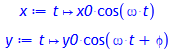
> x:= t -> x0*cos(omega*t);
y:= t -> y0*cos(omega*t + phi);
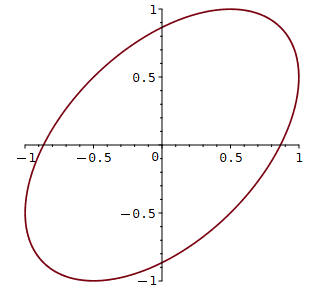
Zahlenbeispiel mit Schaubild:
> x0:= 1: y0:= 1: omega:= 2: phi:= Pi/3:
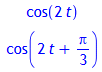
x(t);
y(t);
plot([x(t), y(t), t = 0..4*Pi], opts);
y(t);
plot([x(t), y(t), t = 0..4*Pi], opts);
Fall 2: Zwei zueinander senkrecht stehende Schwingungen mit
Phasendifferenz
Φ und unterschiedlichen Kreisfrequenzen:
> x:= t -> x0*cos(omega*t);
y:= t -> y0*sin(k*omega*t + phi);


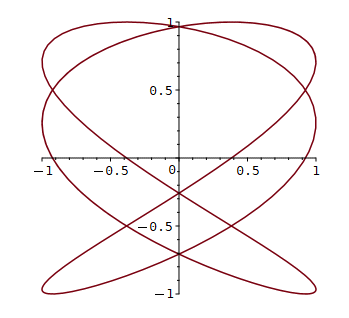
Zahlenbeispiel mit Schaubild:
> x0:= 1: y0:= 1: omega:= 2: k:= 2/3: phi:= Pi/4:
x(t);
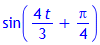
y(t);
plot ([x(t), y(t), t = 0..4*Pi], opts);
y(t);
plot ([x(t), y(t), t = 0..4*Pi], opts);

"Oszilloskopbild" bei variierender Phasenverschiebung Φ:
> phi:= 'phi':
animate ([x(t), y(t), t = 0..4*Pi],
phi = 0..2*Pi,
frames = 80,
size = [250, 250],
numpoints = 1000,
axes = NONE,
color = magenta);
phi = 0..2*Pi,
frames = 80,
size = [250, 250],
numpoints = 1000,
axes = NONE,
color = magenta);

